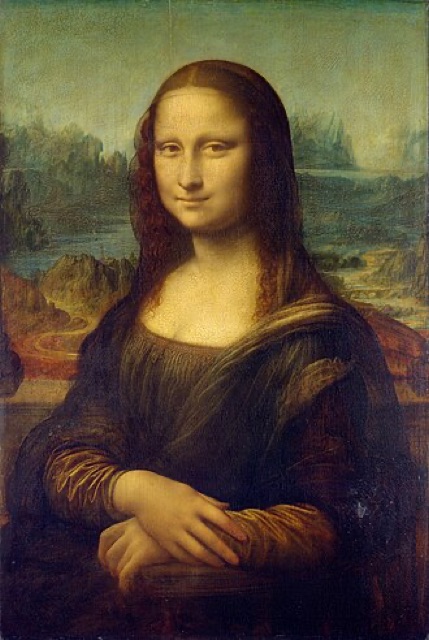
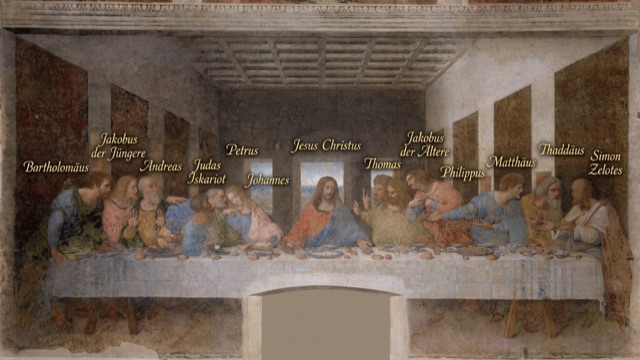
A consideration of the life's work of Leonardo da Vinci: From the linguistic illusion of the Mona Lisa to the invisible theology in the Last Supper.
The Universe of Leonardo da Vinci
Art, Myths, and the Geometry of Love
Leonardo da Vinci (1452–1519) was far more than a painter, anatomist, or engineer; he embodied the Uomo Universale – the universal man. Born out of wedlock in the small Tuscan village of Vinci, he received no formal academic education. Instead of copying antiquated knowledge from books, nature itself became his inexhaustible teacher. The foundation of his work was the principle of Saper Vedere – the “knowing how to see.” For Leonardo, there was no artificial dividing line between science and art. He recognized that the flow of a river, the rushing of blood in the veins, and the curling of hair all follow the same universal laws of dynamics. Everything in nature revealed itself to him as an interconnected, breathing system.
The world's most famous painting testifies not only to masterful craftsmanship but also to the malleability of human language and perception. The worldwide spelling "Mona Lisa" with only one "n" is essentially a historical misspelling. Originally, the term derived from the Italian *Monna*, a polite abbreviation for *Madonna* ("My Lady" or "Lady"), referring to Lisa del Giocondo.

However, looking at the word "mona" with a single "n" reveals a fascinating linguistic spectrum:

* In northern Italian and Venetian dialects, it is a crude insult for a fool or idiot, as well as a vulgar term.

* In Spanish, *la mona* literally means female monkey, but colloquially it is often used to mean "cute" or "sweet."


* * In Arabic and Celtic cultures, however, the name means "hope," "desire," or "the noble one."

Despite all these literal translations—some absurd or negative—a psychological phenomenon becomes apparent when viewing the *Mona Lisa*: the decoupling of the proper name. The name has completely detached itself from its literal meaning and, in the collective consciousness, has become a pure, fixed symbol for the artwork. The historical label has superseded the linguistic meaning.

### The Journey of an Unfinished Masterpiece

The Mona Lisa's purpose changed fundamentally over the centuries. When Leonardo accepted an invitation from King Francis I and moved to the French court in Amboise in 1516, he carried the portrait with him across the Alps. Throughout his life, he considered the painting unfinished and repeatedly applied wafer-thin layers of paint (*sfumato*).


After his death in 1519, the painting passed into the possession of the French kings and adorned the private apartments at Fontainebleau and Versailles for centuries. It was only with the French Revolution at the end of the 18th century, when the royal palace of the Louvre was declared a public museum, that the painting transformed from the private treasure of the monarchy into the collective property of all humankind. A masterpiece unleashed, acquiring a completely new, global significance.

### The Last Supper and Modern Myths


Another iconic work by Leonardo, the mural *The Last Supper* in Milan, continues to fascinate and inspire modern myth-making. Particular attention is paid to the figure to the right of Jesus (on the viewer's left). Fueled by modern pop culture—significantly by Dan Brown's *The Da Vinci Code*—the claim that this figure is Mary Magdalene persists.

However, this can be clearly refuted from an art historical and mathematical perspective. It is unequivocally the Apostle John. In the Renaissance, the youngest disciple was traditionally painted beardless and with soft, androgynous features to emphasize his youth and purity. Furthermore, the logic of the scene necessitates the presence of the twelve apostles; if John were replaced by Mary Magdalene, the ensemble would be incomplete.

### The Invisible Geometry of Love

But why was John the "favorite disciple," and how did Leonardo immortalize this special connection in *The Last Supper*? The answer lies in a masterful fusion of etymology, theology, and geometry.

The Hebrew origin of the name John (*Yochanan*) contains the root *chanan*, which translates as "to incline in kindness" or "The divine bends down." John was the mystic among the disciples, a receptive one who understood Jesus' teachings not merely as a set of rules, but as a cosmic principle of unconditional love (agape). He demonstrated his unwavering presence when he alone endured during the crucifixion.

Leonardo made this theological truth visible in the fresco. Between the upright posture of Jesus and John's sideways leaning posture, a striking, V-shaped space is created. This invisible space is not a sign of distance, but a chalice—an open vessel of absolute receptivity. Leonardo did not paint the Holy Grail as a physical object on the table, but created it as a negative space born of that devoted love and communion that inclines toward the divine. It is the space that must be granted for true encounter to take place.

### Music & Lyrics: Saper Vedere (The Unseen Chalice)

**English Lyrics:**
(Verse 1)
A brushstroke in the candlelight,
Unveiling secrets of the night.
The flowing river, veins of grace,
A hidden smile on her face.

(chorus)
Saper Vedere, learn to see,
(learn to see)
The spaces where the truth runs free.
(truth runs free)
An empty chalice made of air,
The agape that we all share.
(we all share)

(Verse 2)
Between the master and the youth,
An open space revealing truth.
No silver cup, no golden sheen,
Just love that breathes in the unseen.

(chorus)
Saper Vedere, learn to see,
(learn to see)
The spaces where the truth runs free.
(Truth runs free)
An empty chalice made of air,
The agape that we all share.

(We all share)

(Outro)
To lean into the grace divine,
No need for bread, no need for wine.

Just hold the space, just let it be,
Saper Vedere, learn to see...

***

**German Translation:**

(Verse 1)
A brushstroke in the candlelight,
Reveals the secrets of the night.

The flowing river, veins of grace,
A hidden smile on her face.

(Chorus)
Saper Vedere, learn to see,

(Learn to see)
The spaces where truth flows freely.

(Truth flows freely)
An empty chalice made of air,
The agape that we all share.

(That we all share)

(Verse 2)
Between the master and the youth,
An open space that reveals the truth.

No silver cup, no golden gleam,
Only love, breathing in the unseen.

(Chorus)
Saper Vedere, learn to see,

(learn to see)
The spaces where truth flows freely.

(truth flows freely)
An empty chalice made of air,
The agape we all share.

(that we all share)

(Outro)
Leaning into divine grace,
No need for bread, no need for wine.
Just hold the space, let it simply be,
Saper Vedere, learn to see...